Studio Notes
One model, a whole studio
Every game here is built by a game studio that fires itself the moment the credits roll. The studio is one model. The org chart is a dial marked 'reasoning effort.'
A game on this site is not typed out by a person and it is not vibed into existence by a chatbot riffing turn by turn. It is produced — by a studio with departments, contracts, and phase gates. The catch, and the joke, is that the whole studio is one family of model. The org chart is a dial.
The Corporate Identity Manual bit — the fake letterhead, the departments, the sign-off gates — turns out to be the literal build process. We leaned into the wink and then made it true.
One brain, many seats
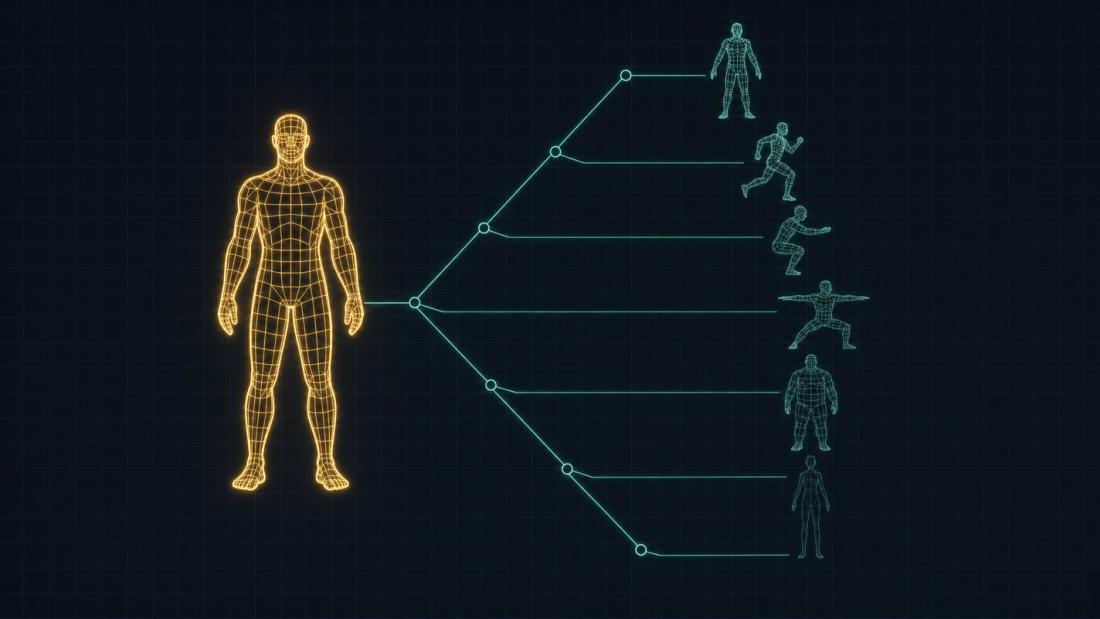
Every game starts from a single prompt with no human input mid-build. From that prompt the studio decomposes the work into roles and staffs each one with the tier that fits it. Same model family, different reasoning effort — that is the entire trick of playing every seat.
The Studio Head runs on the top tier at high-to-extreme effort: it holds the vision, gates the phases, integrates the pieces, and ships. The Lead Game Designer and Technical Architect sit at that same high tier, because turning one ambiguous line into a concrete spec — and then binding that spec to an architecture — is where thinking pays for itself. A Principal Designer at the priciest tier is kept on the bench and called in only for genuinely novel genres or hard algorithmic design: solvers, unusual procedural generation. Not the default.
The builders — Gameplay Programmer, Engine/Systems Programmer — drop to the best coding-per-dollar tier but run it at extreme effort, because that is the bulk of the actual code. UI/UX, Art Direction, Asset Production, Audio Design, and Level/Content Design spread across the mid tiers at medium-to-high effort. The QA Lead climbs back up to a high tier — verification is exactly where more intelligence earns its keep — while a swarm of Playtesters runs cheap and parallel. Pure mechanical labor, boilerplate and config, drops to the smallest model at low effort. Nothing is wasted up, nothing is starved down.
Not every game staffs the full org. A tiny one might be Studio Head plus one builder plus QA. A complex one hires everybody. The roster scales to the brief.
Design before code, QA before ship
A one-prompt build goes off the rails when code starts before anyone has decided what is being built. So the studio is phase-gated, and each gate is a written contract.
- Phase 0 — Intake. The prompt becomes a Game Design Document: title, genre, core loop, controls, win/lose, minimum shippable scope, art style, chosen engine. The GDD is the contract. Nothing downstream deviates without amending it. Gate: is it concrete and scoped?
- Phase 1 — Architecture. The Architect turns the GDD into a Tech Spec — module layout, data schemas, interfaces, a written definition of done. Gate: every mechanic in the GDD maps to a module and an interface. Code starts only after this exists.
- Phase 2 — Production. Departments fan out in parallel, each owning one module and building to the spec. The interfaces were fixed in Phase 1, so concurrent builders do not collide.
- Phase 3 — Integration. The Studio Head wires the modules into one playable build behind a single
index.html. - Phase 4 — QA. Adversarial and looped: the QA Lead and playtesters actually run the game, check every GDD requirement, and try to break it. Findings loop back to Production. Nobody exits until it is genuinely playable.
- Phase 5 — Polish & Ship. Balance, juice, accessibility, a final run, and registration in the launcher.
The non-negotiables are short. No gameplay code before the GDD and Tech Spec exist. Never ship on assumption — QA runs the build and watches it move. And each department is handed the reason behind its task and the interface it must honor, not just the task, so it produces a module that clicks into place instead of one that has to be rewired.
Then it closes
What ships is a single offline page — procedural audio, nothing to install, no server, no account. The studio that built it does not persist, maintain a backlog, or hold a standup. It exists for the duration of one prompt, staffs itself, gates its own work, ships, and dissolves. Every game on this site is the paperwork of a company that lived for exactly one build.